
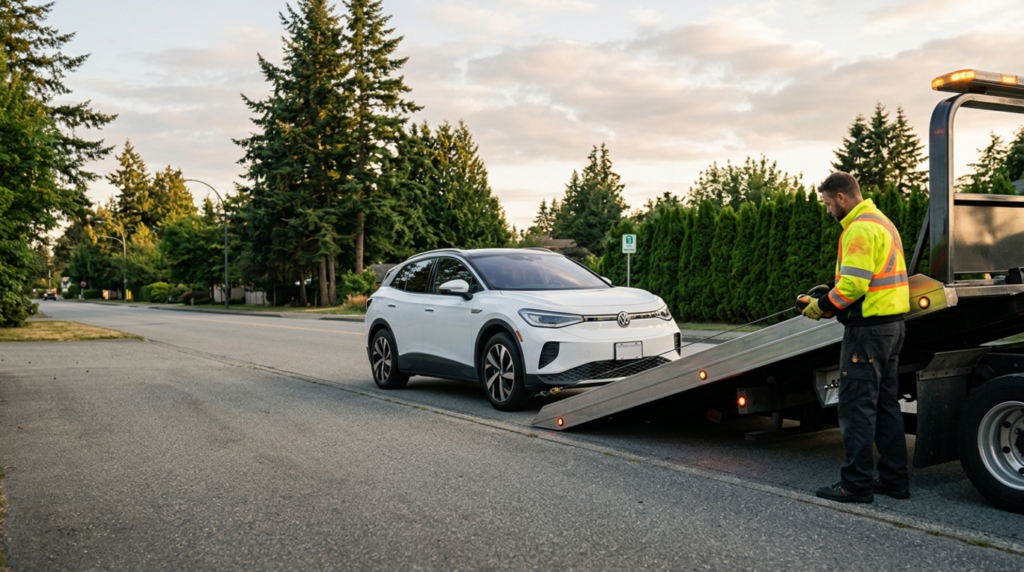
Electric vehicles are reliable, convenient, and increasingly common on the road. People rely on them for daily commutes, school runs, delivery work, local errands, and long road trips. But every EV depends on one simple factor: enough battery power to keep going. And when that battery finally hits zero, the car does not slow down first. It just stops, right where it is.
This moment catches almost every EV driver off guard at some point. The important question is what to do next. Should you call a mobile charging service, or would a tow truck be the safer option? This blog helps you figure out exactly who to call and when.
First, Confirm Why Your EV Has Stopped
Before you call anyone, take thirty seconds to understand what actually happened. Not every stopped EV means a dead battery. Sometimes a software glitch, a tripped safety system, or a loose charging port cover can trigger the same warning symptoms as an empty battery.
Check your dashboard display first. Most EVs show a clear battery percentage or a specific warning icon when charge runs out completely. If the screen shows zero percent or a battery-shaped warning light, you are dealing with a genuine power issue. If instead you see an error code, a flashing symbol unrelated to charge level, or the car simply refuses to start despite showing charge remaining, the problem may be electrical or mechanical rather than a dead battery. Once you know the reason your EV stopped, you can choose the right solution instead of guessing.
When Is Mobile EV Charging the Right Choice?
Mobile charging can help when the EV has simply run out of energy and has no other mechanical or electrical problem. A roadside charging unit supplies enough electricity to help the vehicle reach a nearby public charger. It does not usually provide a complete recharge.
This option may work when the EV sits in a safe and accessible location. The mobile unit must also support the vehicle’s charging connection. A working charging station should be close enough for the temporary charge to get the vehicle there.
However, mobile EV charging is not available in every area. The equipment, connector and charging speed can also vary between providers. For example, BCAA states that it transports an EV to the nearest accessible charging station when the vehicle runs out of charge.
Ask these questions before requesting mobile charging:
- Does the provider support the make and model of the EV?
- How much driving range can the service provide?
- Is a compatible charging station available nearby?
- Can the provider reach the vehicle safely?
- How long will the charging process take?
Mobile charging offers a practical solution when all these conditions align. Towing may provide a safer option when mobile charging is not available.
When Should You Call an Electric Vehicle Tow Truck?
Towing is more practical when mobile charging is unavailable, the nearest charger is too far away, or the EV does not respond after receiving power. You should also request electric vehicle towing in Surrey if the car has collision damage, locked wheels, a battery system fault, or steering trouble.
Do not keep restarting an EV that displays a serious electrical or battery warning. When requesting electric vehicle towing in Surrey, explain the vehicle’s make, model, exact location, battery level, and dashboard warnings. This information helps the towing company send suitable equipment and prepare for the vehicle’s condition before arriving.
Why Does an EV Often Need a Flatbed Tow Truck?
Electric vehicles use motors and drivetrain systems that react differently from those in petrol vehicles. Allowing the wrong wheels to rotate during towing may generate electrical energy, heat, or stress inside the system. The exact risk depends on the vehicle model and drivetrain.
A flatbed tow truck in Surrey, BC can lift the entire vehicle away from the road. This method prevents the wheels from rotating throughout the journey and reduces strain on the electric motor and drivetrain.
Many EV manufacturers provide detailed transport instructions. Tesla, for example, explains that Tow Mode allows a vehicle to roll slowly for a short distance while an operator loads it onto a flatbed. It is not intended for regular road towing.
The operator should review the manufacturer’s instructions before moving the vehicle. The safest towing method can vary by the EV’s make, model, drivetrain, and condition.
Who should you trust for EV Towing Assistance?
Not every towing company understands electric vehicles the way they should, and choosing the wrong provider can turn a simple breakdown into an expensive repair.
When you search for an EV towing service in Surrey, BC, ask a few direct questions before booking.
– Does the company use flatbed equipment for every EV pickup, without exception?
– Are their technicians trained specifically in EV battery safety?
– Do they offer mobile charging as a first response option before jumping straight to towing?
– Are they available around the clock for emergencies?
A provider that confidently answers yes to all four questions is the safer choice for electric vehicle towing Surrey drivers can depend on, whether the issue is a simple low battery or something more serious.
Need Towing Service In Surrey? Call GRD Towing
If you need an EV towing service in Surrey, BC, contact GRD Towing at 778-758-2244 for dependable EV roadside assistance and explain where the vehicle has stopped and what warnings appear on the dashboard. The team can assess the situation and arrange suitable assistance. Professional electric vehicle towing in Surrey can help transport the EV carefully to a nearby charging station, dealership or repair centre.