
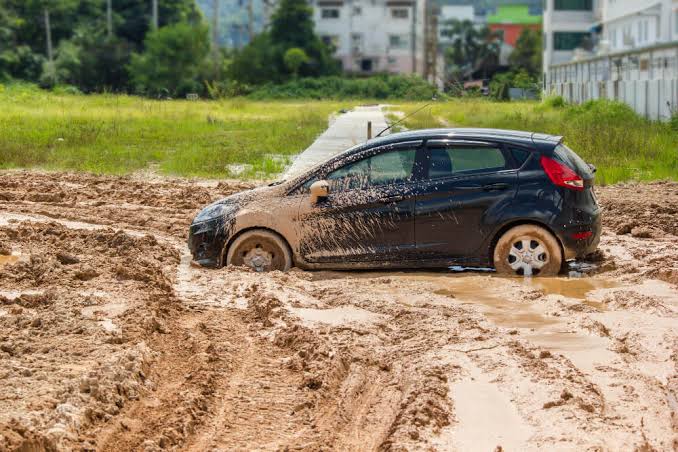
When your car sinks into mud, your mind naturally jumps to quick solutions. You want to get out fast, and that urgency often leads to actions that work against you. These mistakes are extremely common, and most of the time they make the car sink deeper, lose more traction, or suffer avoidable damage. Taking a moment to understand what commonly goes wrong helps you handle the situation safely. In this blog, we will list seven common mistakes drivers make, explained in a way that helps you understand why they happen and how to avoid them.
1. Using Too Much Acceleration Without Understanding Traction
Many drivers press the accelerator harder as soon as the vehicle stops moving. It feels like more power should solve the problem. Mud works differently. When the tire spins quickly, it loses the grip it needs to climb forward. The spinning motion softens the mud under the wheel and makes the tire dig deeper. After a few seconds, the wheel sits lower than before, and the vehicle struggles even more.
A calm and steady approach always works better than force. The tire needs something firm to hold onto, and excessive acceleration takes that firmness away. If you notice the tire slipping, stop immediately and focus on improving traction before trying again.
2. Turning the steering wheel without checking the ground
Many drivers quickly turn the wheel left and right, hoping the car will find a better angle to escape. But when the ground is soft, sharp steering pushes the front tires sideways into the mud, carving deeper grooves. These grooves trap the tires and make it harder for the vehicle to climb out. When you are stuck, the safest approach is to keep the wheel straight until you intentionally create a better path.
3. Ignoring the Mud Packed Around and Under the Tires
Many drivers focus only on pressing the accelerator or adjusting the steering wheel, but they forget to look at what is gathering around the tires. Thick layers of mud often pack themselves tightly around the sides and bottom of each wheel. This packed mud works like a small wall that blocks the tire from climbing out, even if you add traction materials later. You may feel like the car should move because the wheels are spinning, but the mud barrier prevents any real progress.
Taking a few minutes to clear space around and beneath the tires gives them the room they need to roll forward or backward. This small effort often makes a greater difference than several attempts to accelerate.
4. Placing Weak or Unstable Objects Under the Wheels
When you are stuck and running out of ideas, anything nearby starts looking useful. People often place thin plastic, loose branches, or soft cloth under the wheels.
These objects usually slide away instantly or get swallowed by the mud because they cannot support the vehicle’s weight.
Helpful traction materials include:
- Car floor mats
- Thick cardboard
- Wooden planks
- Gravel or small stones
- Traction boards, if available
Avoid objects that bend, fold, or roll easily because they will not help the vehicle escape and may make the tire slip even more. The goal is to give the tire something firm to climb onto.
5. Ignoring Warning Sounds, Smells, and Dashboard Lights
When your vehicle gets stuck, your focus is often entirely on getting it out. At that point, it’s easy to overlook signals from your car. Screaming sounds, a strong burning smell, or dashboard warning lights all tell you that something inside the vehicle is under pressure. These signals appear for a reason. They indicate that the engine, battery, or transmission is reaching its limits.
If you push the vehicle despite these warnings, you risk damaging vital parts that normally function smoothly. Stopping for a while allows your vehicle to cool down, gives you a chance to see what’s causing the warning, and prevents a minor situation from turning into a major repair bill.
6. Letting Out Too Much Air From the Tires
Reducing tire pressure is a helpful technique in muddy situations, but only when done in moderation. Many drivers release too much air because they assume a flatter tire will automatically grip better. Instead, the tire loses its shape and becomes too soft to properly support the vehicle. This can cause the rim to press against the tire, reduce stability, and even make the tire slip off entirely when the car begins to move.
A slight reduction can increase contact with the ground, but going too far creates new risks and makes controlling the vehicle difficult once it gets free.
7. Trying Too Many Attempts Without Considering Professional Help
Many drivers hesitate to call a towing company or a road assistance service provider because they feel they should handle the situation themselves. This leads to repeated attempts that dig the vehicle deeper, create stronger suction under the tires, or strain the engine and transmission. By the time help is called, the recovery takes longer and requires more effort.
Calling a tow truck company early often protects the vehicle and saves time. Professionals arrive with the right tools, safe pulling angles, and recovery methods that free the car without making any damage.
Final Say!
Avoid making the mistakes mentioned above if you ever find your car stuck in mud, because taking the right steps early keeps your vehicle safer and makes the recovery smoother. If you still face difficulty, you can reach out to us for quick and reliable support. Our team understands how stressful these moments can feel; therefore, we arrive with the right equipment to recover your vehicle safely and efficiently. Whether your car is stuck in mud, snow, or any difficult roadside situation, GRD Auto Towing provides responsive and professional assistance across South Surrey, White Rock, Langley, and Delta.